Gretel and Hansel
Content notes: patriarchal notions, child abandonment, poverty, prejudice
A husband and wife lived at the edge of a forest. The wife would have loved to live in the village, but the husband was jealous and wanted to have her close to him and far away from everybody else.
A few months later, the wife became pregnant. Another while later came the child. As it was apparently a girl, the husband was not too excited, but at least he knew his wife was fertile. They called the child Gretel. It did not take too long for the wife to become pregnant again.
When the second child was born, it was named Hansel. The husband was happy, because this child would be his son and heir.
When Gretel turned twelve, her skin started to show light spots on the fingers. She scrubbed and scrubbed, thinking they were stains. But the lighter spots did not fade – they slowly grew and got more defined. At first she hid her hands best as she could, and volunteered to cut the beets, staining her fingers. But one evening her parents found her crying, because she feared that she would slowly bleach out and fade into nothing.
Her mother tried to comfort her, but the husband stayed silent and later confronted his wife. As neither he nor she had anything like this, maybe the father was not him, but one of the men in the village? The wife denied this and as it was only the daughter, the husband chose to believe her for the time being.
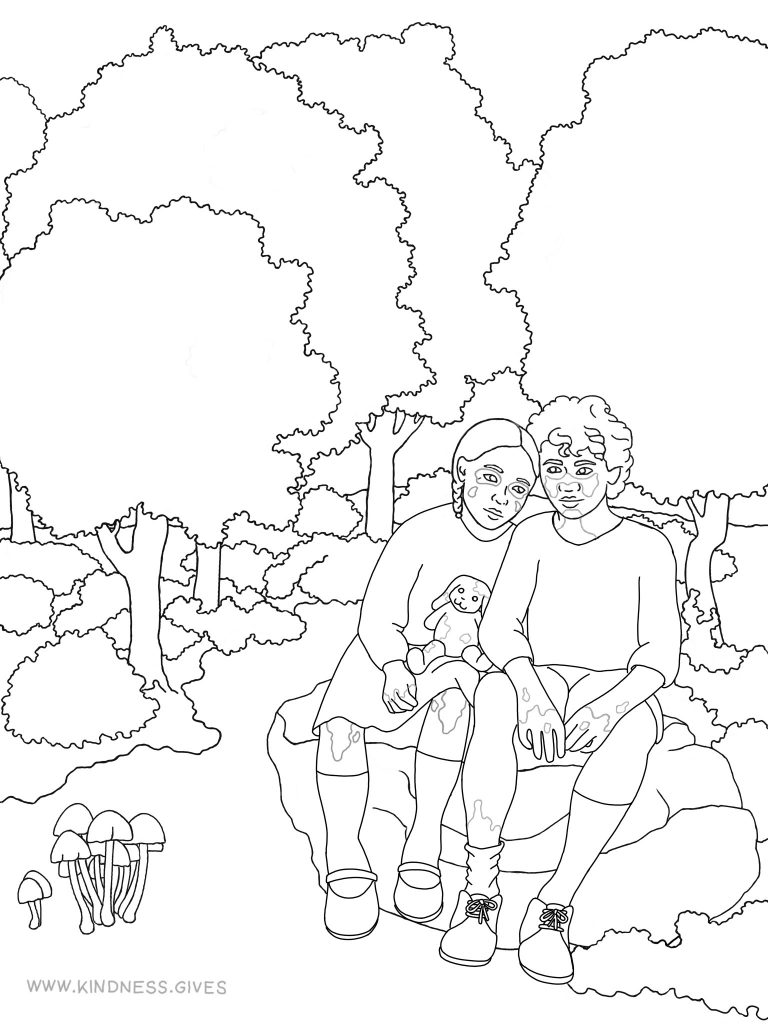
The bright spots on Gretel’s skin started to form patterns, on her hands, knees and face. When Hansel, too, started to show signs of this strange disposition, the father asked his wife again if these were truly his children. The wife confirmed this, but he did not believe a word of it. Instead he gave her the choice to either cast out the children, or to leave with them.
Gretel and Hansel cried when they heard of this, begging their father to not send them away, but he stayed firm. He found it hard to love the children, not knowing if they were really his. He found it hard to love anyone. After imploring her husband to no avail, the wife left with them, to live at her sister’s farm to the west.
After three days of walking, they arrived at the outskirts of a small town, late in the evening. The mother said that the next big building was the farm where her sister lived, but as it was too late to wake her now, they would sleep in the small shed over here and present themselves in the morning.
Gretel and Hansel awoke alone in the shed. They did not know that their mother had gone home again, and the whole endeavor had been a ruse to leave them somewhere in an unfamiliar area.
They waited for their mother to return, but when there was no sign of her for a day and a night, they thought something must have happened. Taking each other’s hands, they walked over to the farmhouse. A young man opened the door. He knew nothing of their mother or her sister. He had just bought the farm, so he could build a life and marry.
The children tried to find their way home, but got lost in one of the woods that they passed through. Having eaten only nuts and berries, the siblings were quite hungry after a few days, when they came upon a clearing. Carefully they looked out from behind the foliage to see if there was any danger about in the form of boars or strangers. At first they just stared at what they saw, because it was so strange a sight and so unfamiliar. Soon they were drawn out in wonder and looked at all that the clearing contained.
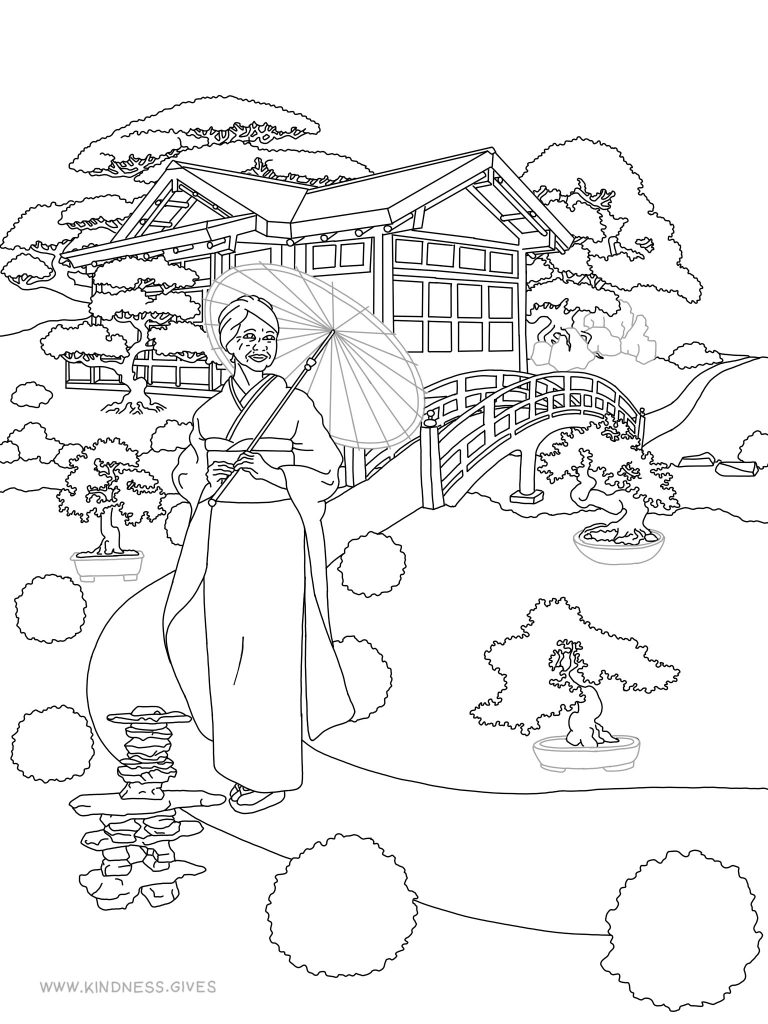
There were trees so small they did not reach Hansel’s knee. There were bushes so round they should have rolled away. A melodiously babbling stream meandered through the clean-cut grass. Following the stream, they came upon a bridge and saw a house behind it, which looked like no house they had ever seen. Made of only a few wooden beams and painted paper, it looked more like a big dolls’ house. The sight of all this strangeness made them giggle.
They heard a noise from the house and quickly hid. A wall was moved to the side and a strange old woman came out, wearing a stiff sort of bulky dress in bright colors, holding a parasol made of paper.
She looked around saying:
“My garden tells me
New feet walk the paths I made
Will you show yourselves?”
When there was no answer, she went inside again, closing the paper wall behind her.
Gretel and Hansel waited for their hearts to slow down before they came out of hiding. Quietly they moved further down the stream, until they found a place where they could wash their hands and drink some water, as they were very thirsty.
Behind them, they heard a sliding sound from the house, and guessed that the woman had come out again. They heard her say:
“My garden tells me
New hands cup the river’s flow
Will you show yourselves?”
Holding their breath as long as they could, the siblings did not move until they were sure that the woman had gone away again. They explored further and found a tree on which mushrooms grew. First, they plucked only a few, but finding them quite tasty – and themselves quite hungry – they ate most of them.
From the house again there came a sliding sound of the wall being moved and they heard a voice carry over to them.
“My garden tells me
New mouths eat the food I grow
Will you show yourselves?”
The children stayed very, very quiet for a long while after they heard the sliding sound again.
Having found water and food, the two were now very, very tired. Under a tree they found a bed of moss where they could lie down and rest, and they soon fell asleep.
They did not hear the sliding sound as the woman left her house.
They did not hear the steps on the path, as she made her way towards them, drawn by the gentle snoring.
“My garden tells me
New heads sleep in shadowed peace
Will you show yourselves?”
Gretel and Hansel did not wake up, because they were so tired.
As they did not wake, they could not hide themselves or be extra quiet, so the woman soon found them sleeping in her garden. She left only briefly to fetch a basket, and then sat herself down on a root, watching over their sleep.
After almost a day, Gretel and Hansel woke and were afraid to find themselves in an unfamiliar place. Looking around, they soon saw the woman sitting close by.
“Fear not, beautiful ones, I mean you no harm,” she said. “I watched over you, so you could rest without being in danger of anything coming upon you out in the open.” She pointed to the basket. “If you want, you can have food and drink, a bath later, maybe, and a chance to recover your strength.”
Gretel eyed the woman suspiciously, while taking a hearty bite of the bread and cheese from the basket. “Why would you do this for us, who are strangers in your garden?”
The woman smiled. “My beautiful child, there are so many reasons why I would want to help you. Whenever you heard me, you hid from me, which means that you were afraid of me. If you are afraid of me, there is no reason for me to be afraid of you as well, is there?
“There are two of you, and where my grandparents came from, they say that good things come in pairs.
“Also,” she added slyly, “maybe being kind to you will give your blessings to my house. I can see that you bring courage and temerity and also good fortune, and who would not want to keep those close?”
Hansel was as confused as his sister. “Why would you think that? And why do you keep calling us beautiful?” he asked around a mouthful of water. No one had done so before, so they were wary of this change.
“Tut,” said the woman, getting up from the root. “You must be courageous and bold to have set out all on your won. And you must have had good fortune in order to make it here. And as for beauty…,” she smiled at both of the scrawny, dirty children. “Your love for one another shines very brightly. How could I not find that beautiful?”
She chuckled. “But now, let us see about your needs.”
Gretel and Hansel followed her, back to the path, through the garden.
“Will you do me the honor and stay with me, my children, so I can take care of you, and will you stay a bit when the time comes where I need you to care for me, before I pass the final gate?”
Gretel and Hansel nodded. Gladly they would stay where they were wanted.
They learned to find joy and peace in tending the garden. As the woman was well loved and respected by her neighbors, the children were soon accepted into the community. First out of friendship for the woman, but gradually also for themselves, as they were always willing and ready to help others out.
In time, even their shyness melted away, and they found true friends. They stayed on when the woman depended on them, and also when the time to care for the woman had passed, as this place was where they felt at home. It was also where they found love and started their own families.
Not all children who lived at the house were born to it, some came there just like Gretel and Hansel had. Some stayed, some ventured forth, when they were ready. When the time came for first Hansel and then Gretel to leave this world, they could go in peace, the house still a refuge and a home for all who needed one.