Both
Content note: mention of ableism, mention of fatphobia
Henrietta’s mother often tried to convince her daughter to buy nice flowing dresses, as they would do so much for her figure! But Henrietta, or Henry for short, did not like flowing dresses and did not mind if people saw that she was fat. “You are not fat, honey, you are beautiful!” was her mother’s usual response. And Henry’s retort was, as always, “I can be both.” Her mother would probably never understand that. It was a generational thing, maybe. Henry was happy the way she was. She had friends, fun and a future ahead of her.
Only sometimes, when she was alone, did Henry allow her mother’s words to hurt. An, albeit short, lifetime of hearing fat and beautiful as different ends on a scale left marks. Once she tried to bring this up with some friends. They told her that this was just her mother’s way of showing her love. That she meant well. That she did not know better. Henry knew all that, because that was what she told herself as well. What she wanted was someone who did not understand her mother, but her, Henry.
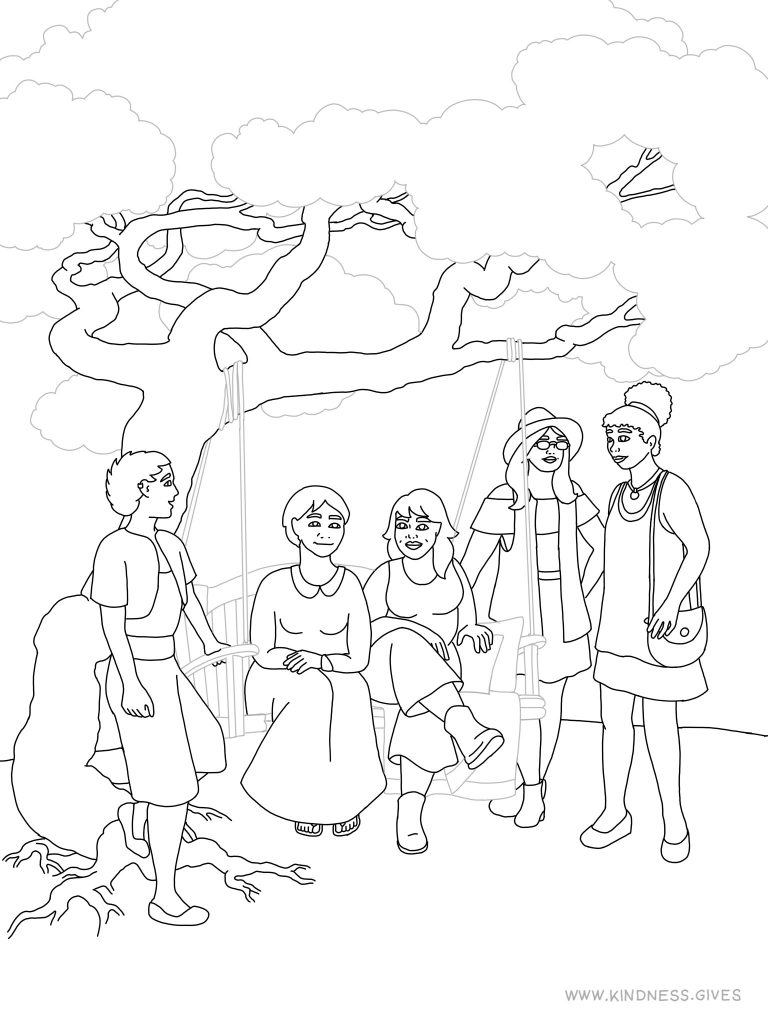
She learned to either push the feeling aside or walk it off. Henry loved walking. There was a park behind the apartment building, and behind the park were some woods that gave way to a forest. The park was too tame, too perfect. The woods were better, but Henry loved the forest. There were no markings on the trees to say which ones needed to be felled. There were no proper pathways. No one told the forest how and where to grow, and as she made her way through the underbrush, Henry felt this strength and freedom seep through her skin. She took a deep breath. The air felt green and damp.
Something rustled in the foliage nearby. A bird, maybe, or a mouse. It did not sound big enough to be a bunny. Henry leaned against the ladder of a long-deserted and overgrown hunting seat and listened to the leaves, the birds, the scuttling of tiny feet. A flock of birds rose from the trees, cawing, flapping. But it was more than one flock. It seemed like all the birds in this part of the forest had decided to take wing at once. Strange.
A couple of deer passed, just visible between the trees. They were rather fast, Henry thought. Was there danger approaching? A wild boar, maybe? Or a fire? But Henry smelled no smoke. A boar would be a problem. Just to be on the safe side, Henry clambered up the ladder. It was mossy and slippery, and two rungs broke when she put her weight on them, but she made it up.
No smoke in sight. She could make out some smaller animals, hares and foxes, that quickly sought cover. Then she heard the pounding of hooves on soft ground. A rider broke through the trees and Henry thought that this was not really a good place to ride that fast. But maybe they were fleeing, too?
“Ho, rider,” she called, to offer a safe spot on the hunting seat. The rider shouted back: “Come down, fast!” Thinking that the rider probably knew more about the situation, Henry hurried down the ladder and heard the rider call: “Jump!” as they came closer. Henry jumped without thinking and found herself pulled by a strong arm onto the running horse, behind the rider. There was no saddle, she noticed. The rider also had no legs. And the horse no head. Something was very odd here. She heard yelling in the distance.
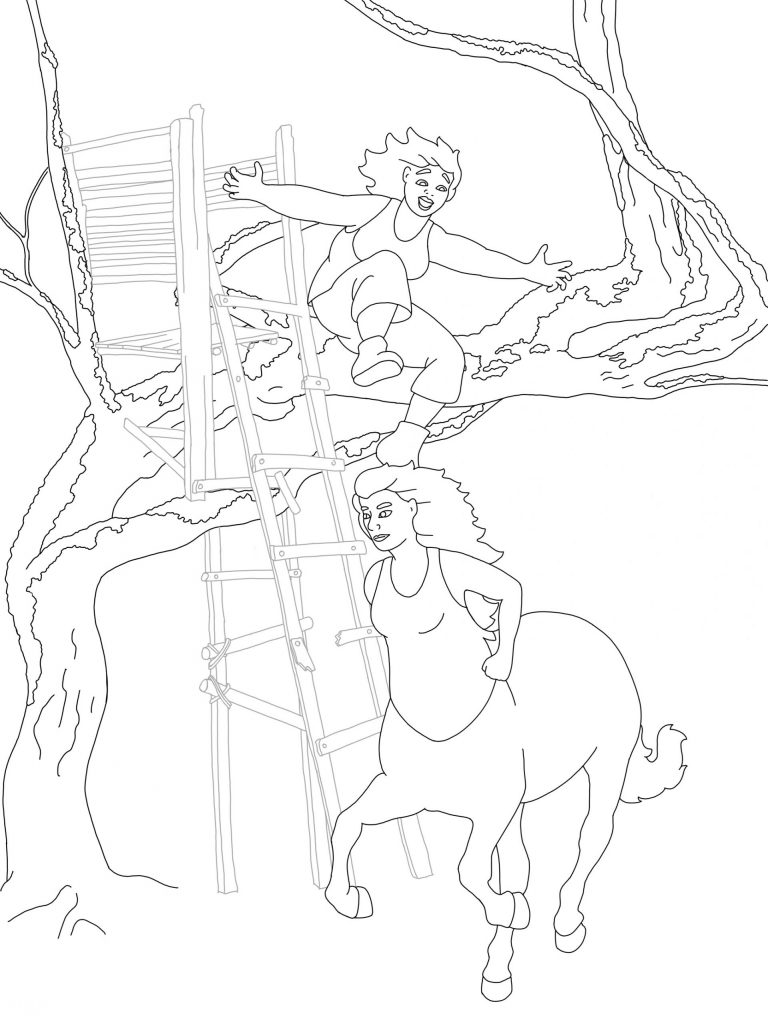
“Rub your arms and legs over the flanks as much as you can and hold on tight!” the rider shouted. Or maybe not a rider at all? “Now!” came the command, as Henry pondered the options. Henry complied – what else was there to do? She could hardly jump off at this fast pace. They crossed a small stream, slowed down, and came to a stop in a secluded clearing that Henry had never seen before.
She fell off rather than dismounted. The other knelt down in the clover beside her. “Are you all right?” As Henry took in the form, half-horse, half-woman, she said: “I do not think so.”
“You are taking this far better than I would have expected,” said the other. “Thanks for your help.” Henry stared unashamed. “The rubbing of your… flanks?” The other nodded. “That and the stream should have thrown them off my scent. Anyway, I am Beatha, maybe the leading mare of the centaurs of this forest, maybe an outcast. The verdict is pending. You may call me Bea.” She offered Henry her left hand and Henry saw that Bea’s right arm ended above the elbow. She took the hand and shook it.
“I am Henrietta. Maybe completely deranged, that verdict is pending, too. You may call me Henry.”
As they sat in the clearing, catching their breaths, Henry asked: “How come you cannot tell whether you are the lead mare or an outcast? – If that is not too personal a question?”
Bea chuckled. “Interesting choice of question. I have been lead mare for over a decade. A couple of months back there was a forest fire in the east. I don’t know if you heard about that?” Henry nodded. They had had to wear fine particle masks for a week because of the heavy smoke blowing over. Before that she had never even heard of that forest, but smoke travels a long way.
“The centaurs from that forest somehow made it here, their herd greatly diminished by fire and other dangers on the way. I decided to take them in, at least until they recovered and could find out if they had a home to return to.” Henry bit her lip. She knew that forest had pretty much burned down completely.
“When it became clear that they had nowhere to go, I offered them a home. Not all in my herd agreed. One of the young hotheads decided that it was time for a new leader. Him.” Bea paused.
Henry asked: “What happened?”
“The tradition demands a challenge. According to this, he and I would have entered an archery contest. He and his followers decided that there was no way I could win that, skipped the challenge, and drove me out. So, depending on your perspective I am either the lead mare, unjustly driven out by rebels, or the outcast former leader after the rebellion.”
“How do you see yourself?” Henry wanted to know.
Bea sighed and gazed at the sky. “It was just a matter of time. I am no leader anymore. I am… impaired.” Henry’s automatic reply was, “You are both.”
Bea stared at Henry. “What do you mean, I am both?”
Henry waved at the bushes and trees. “Nothing is only one thing. That tree over there is struck by lightning and strong. Those mushrooms are small and tasty. These things are not mutually exclusive. I am fat and beautiful. You can be a leader and impaired.”
“Nice speech,” said Bea. “But how?”
Henry thought. “Do you have a right of proxy?”
Bea snorted. “If you need a proxy, your proxy should become leader, not you.”
“Okay, tell me exactly how the tradition goes,” said Henry. And Bea told her:
“In order to replace a leader, you challenge them to an archery contest. The arrows must be shot while running past the target. The target is a bell. Under the bell is a table that holds a plate with sand. If you hit the bell at the exact right angle, the vibrations move the sand. The aim is to get sand off the plate without touching it or the table. The one whose bow gets most sand off the plate wins.” Bea shrugged. “Not much to be done about it.”
Henry pondered this. “Why is it the bow, not the arrow?” Bea got to her feet. Hooves. Whatever. “We all use the same arrows. They fly away to be lost and gone. But we put our spirit in the bow, because the bow stays. The strongest spirit secures the best hit and the clearest sound.”
“Could someone else use your bow? I can shoot,” said Henry.
Bea huffed. “Unthinkable. And even if you tried, the wood would warp when touched by someone other than the maker. You see, it is quite impossible.”
“Not necessarily,” said Henry. “Can he refuse a challenge?”
“If he does, he will be cast out,” said Bea. “One way or the other, it would be over.”
“Will the table need to be set up for the challenge or is it already somewhere?” Henry wanted to know.
“It is always prepared,” said Bea, “To remind us that leading needs to be earned.”
Three days later Henry rode Bea back to where her herd lived. She would be in trouble later when her parents found out that she had skipped school and spent the time away from home in the forest. Three days were hardly enough time, but Bea could not wait any longer. If she stayed away from her herd for too long, her claim on leadership would be irrevocably gone.
They passed a sentinel, who was surprised to see Bea – with a human at that – but would rather see her back in the lead than the youngster who had taken over. He let them pass. Once Bea and Henry were in sight of the herd, excited shouts and whispers erupted. Henry tried not to fall off. She had sort of known that the members of the herd would all be centaurs, but it was something altogether different to see them. Especially as there surely was no such thing as a centaur, let alone a herd of them. “Well, too late for that, now,” muttered Henry.
A path formed between Bea and a proud young stallion, apparently the hothead. The crowd fell silent. The youngster started prancing along the path, towards Bea. He scanned the crowd, reveling in the tension. His eyes settled on Bea, but his dramatic pause lasted a little too long.
“I have come to challenge you. Something you seem to have forgotten.” Bea´s voice was calm, but strong. The stallion laughed, spreading his arms wide. “Be my guest. I will even let you have the first shot.”
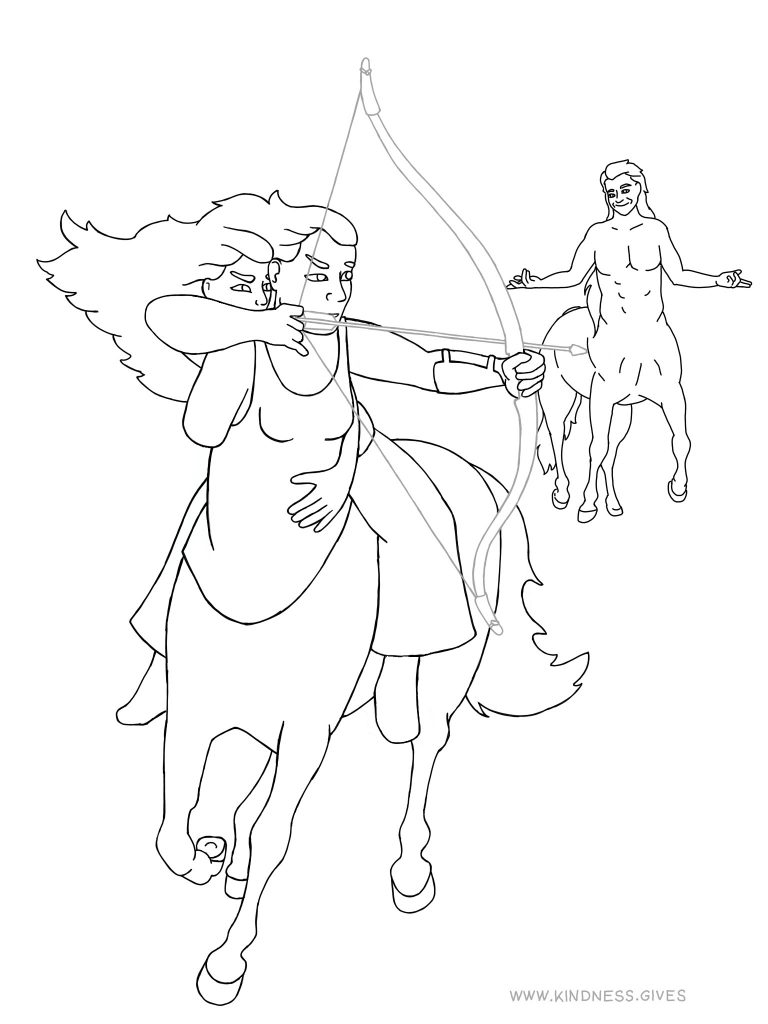
Bea nodded, then hefted her bow and started running, humming the chorus of “The Eye of the Tiger”. Henry buried her left hand in Bea’s mane and tightened her legs as they had practiced, singing along under her breath. Timing was important. Bea raised the bow, holding it steady in her left. Henry nocked the arrow, drawing the string back. They breathed as one. “And he’s watching us all with the eye… two-three-four” – Henry let fly. The bell chimed on the downbeat. “…of the tiger!”
Bea stopped, her back turned on the bell and the table with the plate. “Do we check?” asked Henry. “I have not thought that far ahead. I never thought this would work,” whispered Bea. “Okay,” said Henry, “I am getting off now. You just turn slowly and look at your opponent. His face will tell you, and it would be much cooler than checking out the sand, right?”
Slowly Bea turned around, careful not to let her eyes stray, but pinning her gaze on the young stallion. His face was pale, the bow dangling from his hand, as if forgotten. He got down on one knee, stretching the other foreleg out, and bowed. “Forgive me, lead mare Beatha.”
Without taking her gaze from him, Bea closed the distance between them. “You defied tradition by chasing me off without a challenge. You mocked me when I claimed my right to compete. I could cast you out, to wander without herd or home.”
“I know,” he nodded, not raising his head.
Bea sighed. “You criticized me for sparing others that exact fate, because I wish it on no one. Not even you. You may rise and stay and learn.”
For a good while Bea walked among her herd, accepting congratulations, and greeting friends. Henry stayed to the side, as this was not her moment. Later, when the excitement had died down a bit, Bea sought out Henry. “I shall bring you back home now.”
When Henry dismounted close to home for what she felt would be the final time, she said “There was no sand left on the plate, you know?” Bea nodded. “I know. You did very good. Maybe there is also power in the spirit that nocks the arrow. We will not see each other again, but I will treasure your words and your strength, always.”
When Bea was out of sight, Henry started to wonder if all this had really happened, or if this just had been her journey to Oz, or Wonderland. She shook her head. It had felt real at the time. For a few days the world had held magic and a one-armed centaur who bested her rival because she believed she could be both. And later, whenever things started to become too much, Henry would put in her earbuds, turn up the volume and sing along with Survivor.
“Don’t lose your grip on the dreams of the past, you must fight just to keep them alive!”
She was both. And so much more.